I Bought a Mini PC
June 14, 2026
After weeks researching it, I decided to buy a mini PC to start an “experiment” of building a home lab.
A few months ago I was reading posts from sites like XDA Developers, Make Use Of, and a few others (my Google feed on my phone is full of this kind of content).
My initial motivation was always to depend less on cloud services, but also to learn a bit more about configuring - and shaking off the rust - of different server setups and Docker and Linux skills.
But I’ve also read a lot about becoming a servant of your own home lab, where the time dedicated to it can easily outweigh, by a lot, the benefits of having it.
Mini PC as a portable sandbox
Initially, I don’t want any NAS or a big rack with HDDs, not even a normal-sized desktop.
I considered some old laptops - but the ones I had available were either too old, or too outdated.
So the Mini PC idea seemed the most logical. Even though it doesn’t have a battery or screen, it’s easy to carry around (and I already have a portable monitor).
Although “home lab” and “portability” don’t necessarily converge in every scenario, my use cases - which go beyond having several docker containers running - justify it for now. But that’s a subject for another post.
The chosen model
After watching several reviews, making several comparisons using Gemini and Claude, I arrived at the chosen model: Minisforum UM 880 Plus.
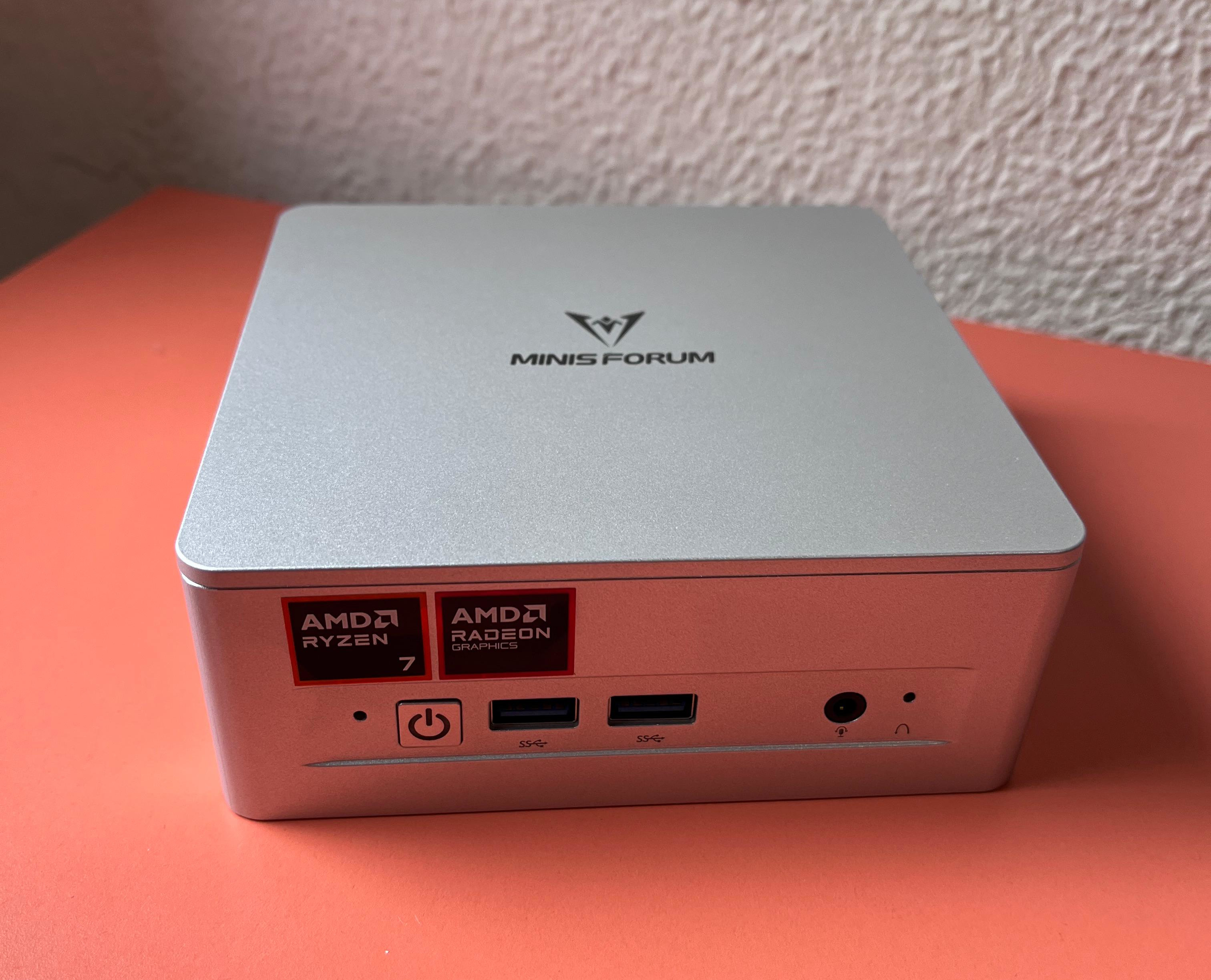
This model has a Ryzen 7 (Zen 4) 8845HS 8C16T processor, with a base clock of 3.8GHz and a max of 5.1GHz. The default TDP is 45W and it has the Radeon Vega 780m as integrated graphics.
LAN 2.5G, HDMI 2.1, DisplayPort 1.4, Oculink, a 3.5mm jack, 2 USB 2.0 and 2 USB 2.1 ports are provided.
I’ll tell a bit more about the reasons that led me to choose this model.
Processor and Integrated Graphics
At first, this mini PC wouldn’t be used only for simple home lab tests. I also wanted a machine good for light and medium games.
Besides, I wanted something future-proofing, so a Ryzen with 8 cores and 16 threads - even though it was released more than 3 years ago, seemed like the right choice to me.
It’s not quite a Ryzen 9 - but it already has the best integrated card for this architecture (the Ryzen 9 has the same Radeon 780m).
Cooling: the good old thermal paste
Remember the portability I mentioned earlier? I still have some fear of carrying in my backpack a Mini PC that has cooling that uses liquid metal.
Besides, some other Mini PCs I considered have PCM (Phase Change Materials) - but a future maintenance might not be as simple as just swapping a thermal paste.
Anyway, it might be an attachment to old-school methods that proves irrelevant in the future, but I preferred not to risk it for now.
Oculink port and USB-C charging
In the future I intend to plug a graphics card (using an appropriate base) into this computer, and the Oculink port - despite using the space of an SSD - has more bandwidth than a Thunderbolt 4 port.
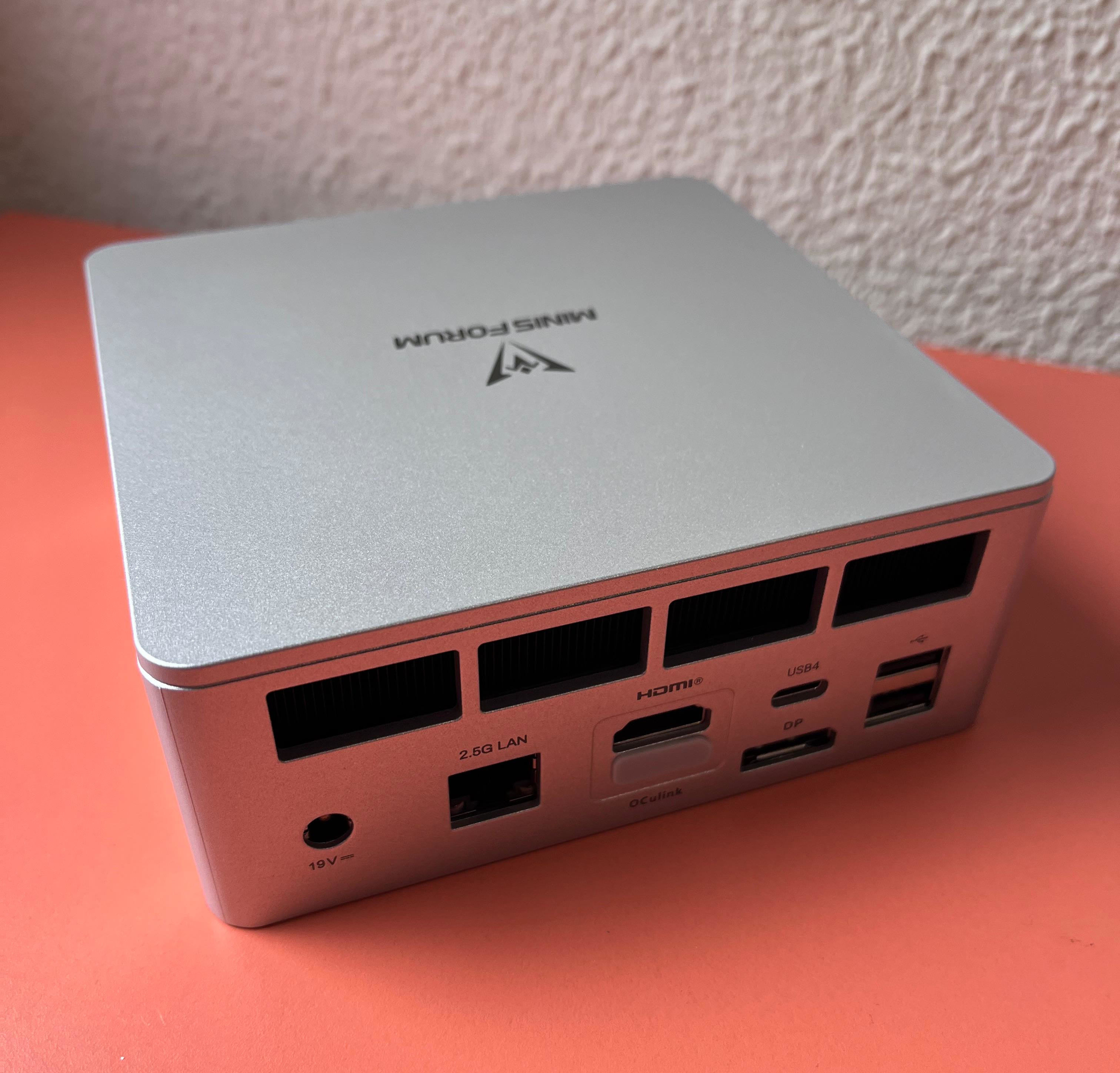
By the way, speaking of this port, this model has it too. And that’s useful because I can use a GaN USB-C charger without always depending on the power supply that comes with the Mini-PC (I won’t get all the 130W the power supply provides, but I won’t always need it).
Noise level
The benchmarks of this model show a great noise level compared to some competitors.
I even considered a GMKtec model that has 2 LAN ports (which can be useful for some home lab things) - but since this won’t be a PC that stays isolated in some hidden corner, I care a lot about low noise.
HDMI 2.1
The HDMI 2.1’s capability of transmitting 4k at 60hz was important here. Of course, with the integrated graphics capability, only light games can achieve this frame rate at 4k.
But in the future, this mini PC could become a Moonlight receiver of a sunshine stream that could be on a gaming PC in another corner of the house.
Minisforum
Maybe the brand had a bit of weight in this choice. They were pioneers in several mini PCs and related hardware (like the docks for eGPU) and the brand’s support seems solid to me. So it was one more point for this model.
DDR5
Here we have a characteristic that is positive and negative, depending on the point of view: this Mini PC has 2 DDR5 SO-DIMM RAM slots.
The positive point is that, in the idea of being future-proof, DDR5 is newer and faster than DDR4.
The negative point is that I bought maybe at the peak of the memory price surge, which rose dramatically since September last year - so the cost of the memory is very high.
Extras
For this mini PC I opted for 2 Crucial DDR5 5200MHz CL46 memory sticks, with 16GB each. Since I also want to run some light LLMs like Qwen, 32GB should be enough (and save my wallet from an even bigger expense while the RAM prices don’t normalize).
And for storage, I opted for a 1TB Lexar NM790. The advantage of this model is having 1000TBW of capacity.